Move with ease. Sense new possibilities.
A shared class, a personal exploration. Gentle movements become a way to notice habits, try alternatives, and listen more closely to yourself.
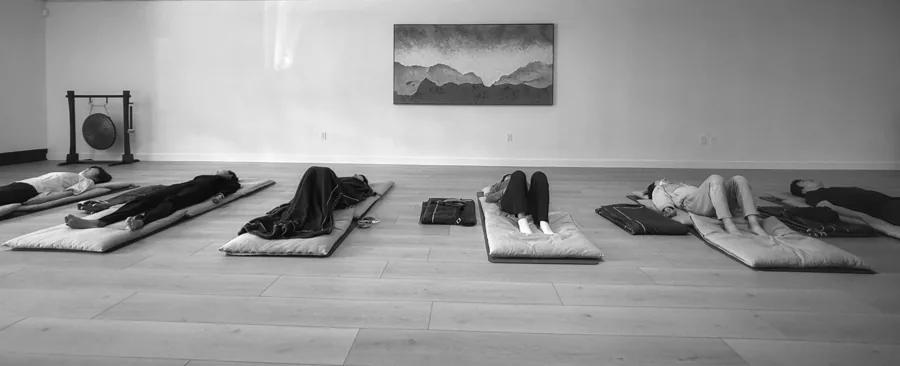
ATM Group Class at Talo Yoga
Join Elaine for Awareness Through Movement® at Talo Yoga in Palo Alto. Explore gentle movements at your own pace, with time to notice, pause, and rest.
An ongoing 60-minute group class. Visit Talo Yoga’s booking page for current dates, times, and availability.
Drop-in is $38, with other pricing options available through Talo Yoga. Check the booking page for options and availability. Registration is handled by Talo Yoga through Arketa.
Talo Yoga · 437 Cambridge Ave, Palo Alto, CA 94306
View map & directions
What is an ATM class?
Awareness Through Movement® (ATM) is the group lesson format of the Feldenkrais Method®. You follow spoken invitations and explore movements at your own pace. There is no perfect pose to copy.
The class offers a setting for learning through your own experience. You notice what feels familiar, what takes effort, and what changes when you try another option.
Space to move, breathe, and notice
A lesson invites you to notice the connections between movement, breathing, feeling, and attention. These explorations weave together, with room to follow your own pace.
A welcoming space, with choice
Begin in a comfortable position. There is no performance to achieve or judgment to meet. You can adapt an invitation, rest, or choose not to take part.
Gentle movement, new options
Explore small variations with less effort. Notice where you habitually tighten or hold, and compare what happens when you try another way. Curiosity guides the movement.
Breathing, without forcing
Let your breath find its own rhythm. Notice whether you hold it during a movement, or whether it changes when you move more comfortably. There is no prescribed breathing pattern.
Pauses to sense what is there
Rest between movements. Feel your contact with the floor, your breathing, and any sensations or feelings that arise. You do not have to explain them or make something happen.
Bring the experience together
Return to sitting, standing, or walking. Notice how you feel as a whole, and what you might carry into daily life—perhaps a little more ease, awareness, or choice. Experiences vary.
A neuroscience perspective
Neuroplasticity is the nervous system’s capacity to change with experience and learning. Research on adult motor learning shows that practice can be accompanied by changes in brain activity and movement representations.
In ATM, we learn through sensory feedback, movement variations, and repeated exploration; pauses give us time to rest and compare. This is a way of understanding the practice. The cited research did not test this class or establish that a particular movement activates the vagus nerve or treats trauma.
Karni et al. (1998) · Motor learning and adult brain plasticity
Learning how to learn
Learning begins with noticing differences. Does a movement feel heavy or light? Comfortable or uncomfortable? Does one way take more effort than another? A small variation or a pause gives you a chance to compare your experience.
There is no correct sensation to find. By paying attention to these differences, you begin to recognize your habits, preferences, and what feels comfortable for you. Learning how to learn is also a process of getting to know yourself—through your own experience, with curiosity rather than judgment.
Questions & guiding principles
What does “less is more” mean?
The Weber–Fechner law offers a helpful way to think about noticing differences: within certain ranges, our perception depends on a change relative to what is already present. Imagine switching on a small lamp in a dark room—the change is easy to notice. Switch on the same lamp in an already bright room, and the difference is much less noticeable. As an analogy for ATM, reducing unnecessary effort can make subtle differences in movement easier to notice. We explore with slow, small, and gentle movements, within a comfortable range. Slowing down gives us time to feel the details, while using less effort helps us notice subtle changes. “Less is more” means making room for awareness, rather than always making the smallest possible movement.
Is the movement itself unimportant?
Movement is a vehicle for developing awareness. This is why we call it Awareness Through Movement®: we use movement to learn about ourselves, rather than using awareness simply to achieve a particular movement. The aim is not to perform a perfect shape or move as far as someone else. We do not compare ourselves with one another, and we do not need to analyze every sensation or judge our movements as good or bad. Instead, we notice how we move, what we feel, and what changes—with curiosity and without judgment. Each person’s experience is their own.
Why do we pause between movements?
Pauses are part of the learning. They give us time to rest, feel the effects of a movement, and notice what has changed. Does the body feel lighter or heavier? More comfortable, or different in some other way? Rather than immediately doing more, we make space to take in and integrate what we have learned about ourselves. When we begin again, we can compare our experience and discover something new. You are welcome to pause whenever you need; there is no need to keep up.
Why might I feel sleepy, and what if I fall asleep during a lesson?
There is no single explanation for every person. Quiet pauses and lying down may make existing tiredness more noticeable; insufficient sleep can also contribute to dozing. Sleepiness alone does not tell us that healing or a particular nervous-system change is taking place. There is no need to feel embarrassed. Rest if you need to, then rejoin when you feel ready. You can open your eyes or ask about a more upright position. Rest is welcome, and the invitation is to return to comfortable, awake attention when possible.
Do I need to be flexible or experienced?
No particular flexibility or movement background is required. Start with a comfortable range. Ask about adaptations or access needs before class so we can discuss whether the setting fits you.
Should I push through discomfort?
No. Reduce the movement, rest, or stop. Let Elaine know if an invitation does not work for you. You are always free to decline it.
Is this exercise, meditation, or therapy?
ATM is an educational movement practice. For me, exploring through ATM has something in common with mindful observation of the body (观身): we use movement to become aware of our bodies and our present experience, while also noticing feelings, emotions, thoughts, memories, images, or impulses that may arise. Without rushing to analyze, compare, or judge, we gradually get to know ourselves through observation. This is a connection I draw from my own practice; ATM and Buddhist meditation remain distinct practices. ATM is not a workout aimed at intensity, and Nature Somatic does not offer it as medical treatment or psychotherapy.
What should I bring?
Wear comfortable clothing. Any mat, seating, or other arrangements will be listed with the confirmed class details. For outdoor classes, the location and weather arrangements will also be shared in advance.
Begin with a question
You are welcome to ask about current group-class availability and what a first lesson might be like.
Ask about a group classCurious about working together?
Whether you're interested in an individual session, a class, or an upcoming workshop, you're welcome to reach out.